#AdvantAge
An innovative approach to age assessment for minors leveraging multiple, non-intrusive methods.
Background: Initially started at a humanitarian hackathon in October 2017, AdvantAge is an initiative looking at different tools to improve age assessment practices of migrant children. Tools include machine-learning, artificial intelligence, image recognition, hearing tests, and DNA testing.
Background
1. The necessity of accurate age assessment procedures.
Precise age assessments are therefore essential, as they help ensure that the rights and wellbeing of children are respected during procedures and that protection measures appropriate to their needs are implemented, especially when national authorities are involved.
2. Identified problematic: Existing techniques are inaccurate and intrusive.
Existing practices for determining a person’s age based on physical attributes are intrusive and are ethically questionable. All of them have a margin of error of at least two years.
Findings/ Project overview
Combinative information system
Multiple procedures for assessing age are becoming available with newer technologies. None of these provide exact measures, and as such, an information system can be built to house results from multiple sources. A “Dashboard” would allow for an easy view of results from different sources. As new procedures are developed, they could be added as a dashboard item.
This would allow migration officers to have all the information concerning age in a single location. Additionally, a record could be provided to the applicant themselves, which may be useful for later appealing a negative decision by a migration officer or other host-country legal entity.

Age estimation from 2D photographs

Advances in Machine Learning have led to the ability for algorithms to be able predict a person’s age from a photograph, with a 1-3 accuracy range. During the Hackathon, a system was developed to perform these predictions based on an existing Caffe model, developed during research in 2015.
HEARING TESTING
Advances in Machine Learning have led to the ability for algorithms to be able predict a person’s age from a photograph, with a 1-3 accuracy range. During the Hackathon, a system was developed to perform these predictions based on an existing Caffe model, developed during research in 2015.
INFORMATIONAL POSTER
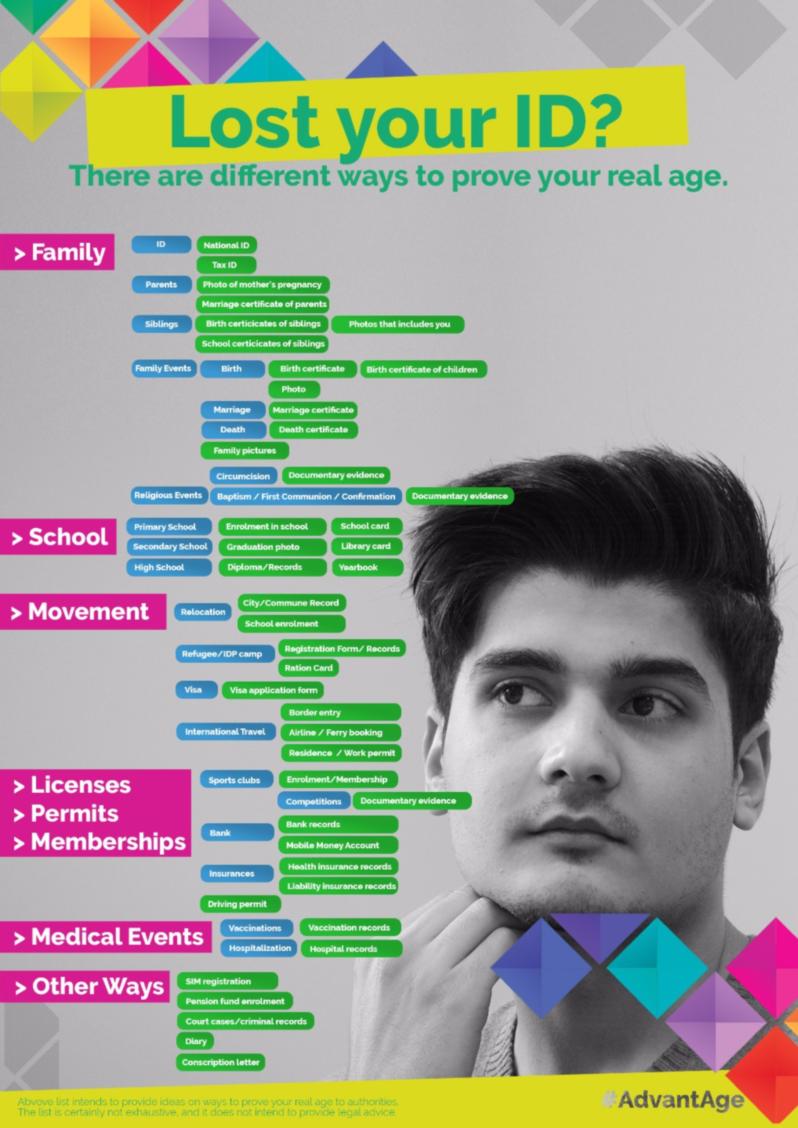
Newly arrived migrants without papers often do not know where they can find documents which could prove their age. A simple and attractive poster (appendix A) was created to provide a visible and easily-understandable source of information for young migrants who need to prove their age.
Outlook
- AGE ESTIMATION FROM 3D PHOTOGRAPHS
- DNA testing
- TRAINING DATA COLLECTION
Combinative Information system

Multiple procedures for assessing age are becoming available with newer technologies. None of these provide exact measures, and as such, an information system can be built to house results from multiple sources. A “Dashboard” would allow for an easy view of results from different sources. As new procedures are developed, they could be added as a dashboard item.
This would allow migration officers to have all the information concerning age in a single location. Additionally, a record could be provided to the applicant themselves, which may be useful for later appealing a negative decision by a migration officer or other host-country legal entity.
AGE ESTIMATION FROM 2D PHOTOGRAPHS

Advances in Machine Learning have led to the ability for algorithms to be able predict a person’s age from a photograph, with a 1-3 accuracy range. During the Hackathon, a system was developed to perform these predictions based on an existing Caffe model, developed during research in 2015.
This model was built on a public database of celebrity photographs. As such, the database’s subjects are adults and overwhelmingly American and Caucasian. The database is not indicative of migrant children from Africa or the Middle East.
Machine Learning approaches require large amounts of data on a subject to be effective. 100,000 images of children with associated ages would be an effective training set, and further advances in Machine Learning since 2015 mean possibilities for an effective system are strong, if such a database could be assembled.
Development of a database of photographs of children has many ethical issues, and would need careful consideration and oversight, should it be created.
HEARING TESTING

Hearing degradation with age, even for young people, is well understood and can be used as a complimentary approach to estimation of age from photographs. Consideration of exposure to explosions, gunshots and other loud noises must be carefully assessed when using this method to assess age.
A proof of concept application for estimating age based on auditory ability was developed at The Port Hackathon, and has been integrated into the AdvantAge system.
INFORMATIONAL POSTER